
Speech Delay in Children: Early Signs Parents Should Know
Every child picks up language at a slightly different pace, and comparing one toddler’s chatter to a cousin or classmate rarely gives an accurate picture. Still, there is a recognized range for when speech and language skills typically appear, and stepping outside that range for long enough is worth a closer look from a child specialist in Palam Vihar. Catching a delay early, rather than adopting a wait-and-see attitude indefinitely, tends to make a real difference in how quickly a child catches up.
What Counts as a Speech Delay
Speech and language are related but not identical. Speech refers to the physical act of forming sounds and words clearly, while language covers the broader ability to understand others and express thoughts, whether through words, gestures, or later, sentences. A child can struggle with one area without the other being affected at all. A delay simply means a child is behind the typical timeline for their age in one or both of these areas, not that anything is permanently wrong.
Typical Language Milestones by Age
By around twelve months, most babies babble with changing tones and may say one or two simple words with meaning, such as mama or dada. By eighteen months, a vocabulary of ten to twenty words is common, along with pointing to indicate wants. Around age two, many toddlers begin combining two words into short phrases like more juice or go park. By three, most children can be understood by familiar adults most of the time and can follow two-step instructions with reasonable ease.
Early Signs Worth Watching For
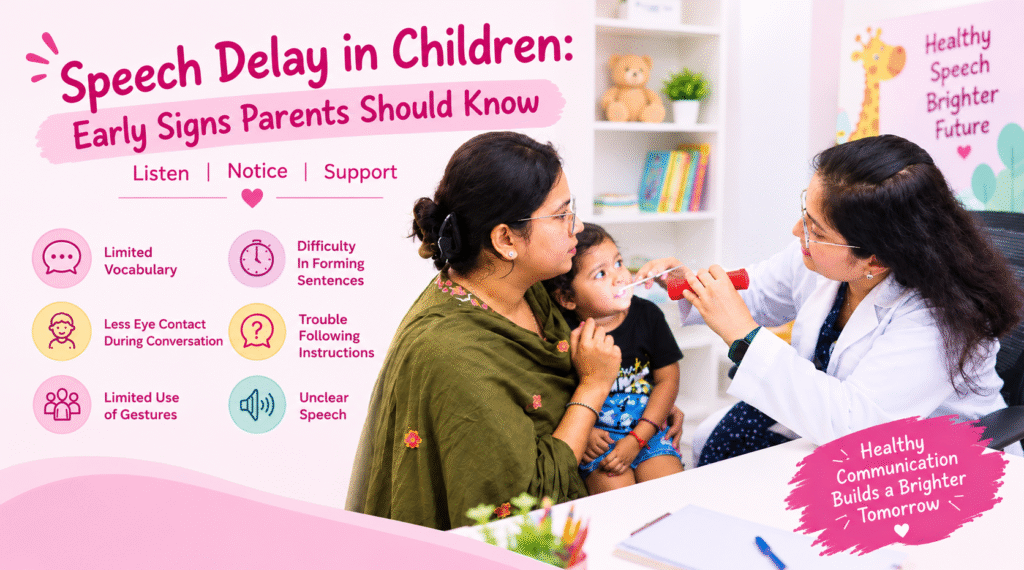
A few patterns tend to stand out well before formal testing is even considered. These include a baby who does not babble at all by nine months, a toddler who is not saying single words by sixteen months, no two-word combinations by two years, or a noticeable loss of words the child previously used. Difficulty following simple instructions, limited eye contact during interaction, or frustration that seems tied to not being understood are also worth noting rather than dismissing as shyness.
Common Causes Behind Delayed Speech
A number of factors can contribute to slower language development, and often it is a combination rather than a single cause. Frequent ear infections that affect hearing during a critical stage, limited verbal interaction at home, being raised in a bilingual household with a temporary mixing period, or a broader developmental condition can all play a role. In many cases, no clear reason is ever identified, and the delay simply resolves with the right kind of support and practice.
What Parents Can Do at Home
Simple daily habits can support language growth even before any formal evaluation. Narrating everyday activities out loud, reading together regularly, and pausing after asking a question to give the child time to respond all encourage speech naturally. Limiting background screen time, since passive viewing does little for language compared to back-and-forth conversation, and responding warmly to any attempt at communication, even a gesture, reinforces the idea that trying to communicate is worthwhile.
When to Seek a Professional Opinion
If a child falls noticeably behind more than one of the usual markers, or if a parent’s instinct says something feels off despite reassurance from family, a conversation with the best pediatrician in Palam Vihar is a reasonable next step rather than waiting several more months. A hearing check is often one of the first things ruled out, since even a mild, undetected hearing issue can quietly slow language development for a long stretch of time.
The Value of Early Intervention
Research consistently points to better outcomes when support begins early rather than after a long delay. A referral to a speech therapist through a child specialist in Palam Vihar often involves a straightforward assessment, followed by targeted, play-based sessions that fit naturally into a child’s routine. Many children close the gap significantly within a matter of months once consistent, structured practice becomes part of daily life at home and, where applicable, at school.
Conclusion
A slower start with words does not automatically signal a lasting problem, but it is not something to brush aside indefinitely either. Watching the early markers, engaging in everyday conversation, and asking questions sooner rather than later gives a child the best possible chance to catch up smoothly. Dr. Sonali Gaur regularly reminds parents that a brief check-in with the best pediatrician in Palam Vihar costs little beyond a short visit, while waiting too long can occasionally cost valuable time during a stage when the brain is especially receptive to learning language.